(/ˌtaɪtənəˈboʊə/;[1] lit. 'titanic boa') is an extinct genus of giant boid, the family that includes all constrictors and anacondas, snake that lived in what is now La Guajira in northeastern Colombia during the middle and late intervals of the Paleocene. Titanoboa was first discovered in the 2000s by students from the University of Florida and the Smithsonian Tropical Research Institute, recovering over 186 fossils of Titanoboa from the site. It was not named until 2009 in the journal Nature, being dubbed Titanoboa cerrejonensis, the largest snake ever found. It was originally known from purely thoracic vertebrae and ribs, but later expeditions collected parts of the skull and teeth. Titanoboa is in the subfamily Boinae, being most closely related to other extant boines from Madagascar and the Pacific.
They could grow up to 12.8 m (42 ft), perhaps even 14.3 m (47 ft) long and reach a body mass of 730–1,135 kg (1,610–2,500 lb). The discovery of Titanoboa cerrejonensis led to it supplant the previous record holder, Gigantophis garstini, which is known from the Eocene of Egypt.[2] This snake evolved following the extinction of all non-avian dinosaurs, being one of the largest reptiles to evolve after the Cretaceous-Paleogene Extinction event. Its vertebrae are very robust and wide, with a pentagon-shape in anterior view, as in other members of Boinae. Although originally thought to be an apex predator, the discovery of skull bones revealed that it was more than likely specialized in preying on fish.
15 feet crocodiles,10 feet lungfishes,and 10 feet giant turtles such as Carbonemys,were just foods for the 42 feet snake.The apex predator of paleocene epoch.
In 2002 during an expedition to the coal mines of Cerrejón in La Guajira[3] that had been launched by the University of Florida and Smithsonian Tropical Research Institute,[4] the large thoracic vertebrae and ribs of snakes were unearthed by the students Jonathon Bloch and Carlos Jamarillo of the two institutions.[5][6] The expedition lasted till 2004, in which the fossils of Titanoboa were mistakenly labeled as those of crocodiles.[7] Cerrejón is in the Cerrejón Formation, dating to the mid-late Paleocene epoch (around 60-58 mya), a period just after the Cretaceous–Paleogene extinction event. More fossils were unearthed during the year, eventually amassing to a total of 30 individuals and 186 fossils in total, which were found in association with other giant reptile fossils of turtles and crocodilians. Before this discovery, few fossils of Paleocene-epoch vertebrates had been found in ancient tropical environments of South America.[8] The fossils were then transported to the Florida Museum of Natural History, where they were studied and described by an international team of Canadian, American, and Panamanian scientists in 2009 led by Jason J. Head of the University of Toronto.[4] The snake elements were described as those of a novel, giant boid snake named Titanoboa cerrejonensis in their study, becoming the largest snake known. The genus name derives from the Greek word "Titan" in addition to Boa, the type genus of the family Boidae. The species name on the other hand is a referebce to the Cerrejón region it is known from.
A later expedition to Cerrejón was conducted in 2011, finding a new array of fossils from Titanoboa.[7] Most notably, the group returned with three disarticulated skulls of Titanoboa, becoming one of the few fossil snakes with preserved cranial material. They were associated with postcranial material, cementing their referral to the snake.[9] Though the skulls are undescribed, an article by the BBC in 2012[10] and an abstract in the Society of Vertebrate Paleontology have been published.[9] A documentary on the animal titled Titanoboa: Monster Snake aired in 2012 in addition to a touring exhibit of the same name, which lasted from 2013 to 2018.[11]
Here is the size of mordern and some prehistoric giant snakes compared to Titanoboa
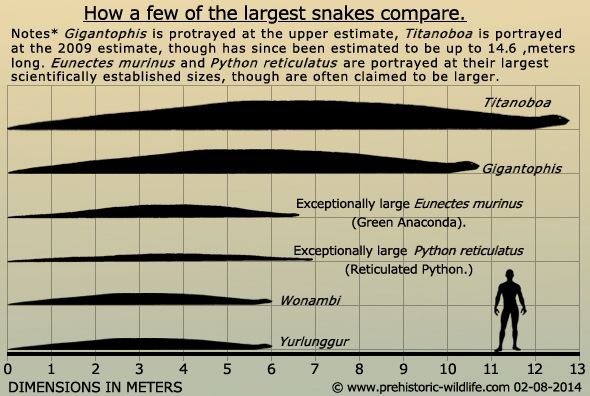
Who will win a fight between Titanoboa and Sarcosuchus(Bonus question)
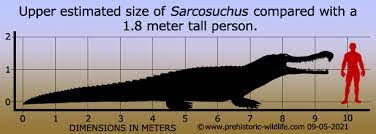
Sarcosuchus,one of the largest crocodile in history.Live during 110 million years ago in North Africa,the early cretaceous period.Average length is about 31 feet,or 9.5 meters.Some large indivisuals could even reach up to 40 feet,12.2 meters in terms of length.Weight about 4 to 6 tons,up to 8 tons.It's name meaning flesh crocodile.Sarco means flesh in Greek,Suchus or Sochus means crocodile in Greek.Similiar to modern crocodiles,it camouflage on water surface as a punk or wood,when dinosaurs or other animals drinking water.Sarcosuchus then jump out and capture that dinosaur and drown it.Note:Sarcosuchus can't do death roll like saltwater crocodile,because it's jaw is too thin to do it trick.But it's has a really hard shell plate on it's back or resistance and protection luckily.Even large carnivore dinosaurs are struggle to damage it.
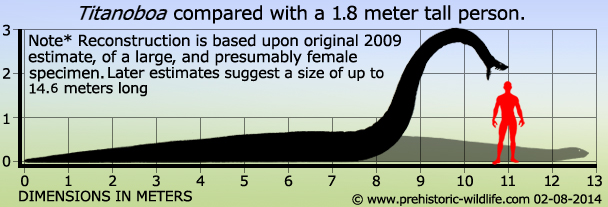
Titanoboa is the largest snake in the world ever exist.33 to 41 feet or 10 to 12.5 meters length on average,up to 50 feet or 15 meters maximum.It has a thick body for 3 feet.Live during 58 million years ago, in the South America Amazon Rainforest.It's name titanoboa, in Greek means Gigantic boa.Weight as much as a car,around 1.2 tons.Titanoboa usually use suprise attack,then wrap around prey's body,and squeeze it hard until the prey's organs,and heart failures.Then swallow it whole.Similiar to sarco,it skin could also camouflage in swamp and blend in.
Who Will Win?
Sarcosuchus would win eventurally.Because of Sarcosuchus has the size,weight,and speed advantages.Regardless how the titanoboa would wrapping around sarco and try to kill it.On land,Sarcosuchus could just simply outmanuver the giant snake and land attacks on it easily.So does it in the water.It's even faster.Sarco is faster,smarter,and heavier.So in the end,Sarcosuchus Wins.